The job started clean. Everyone showed up ready. Tailboard was tight. Tools staged, roles clear, crew moving with purpose.
Then someone made the first move without syncing.
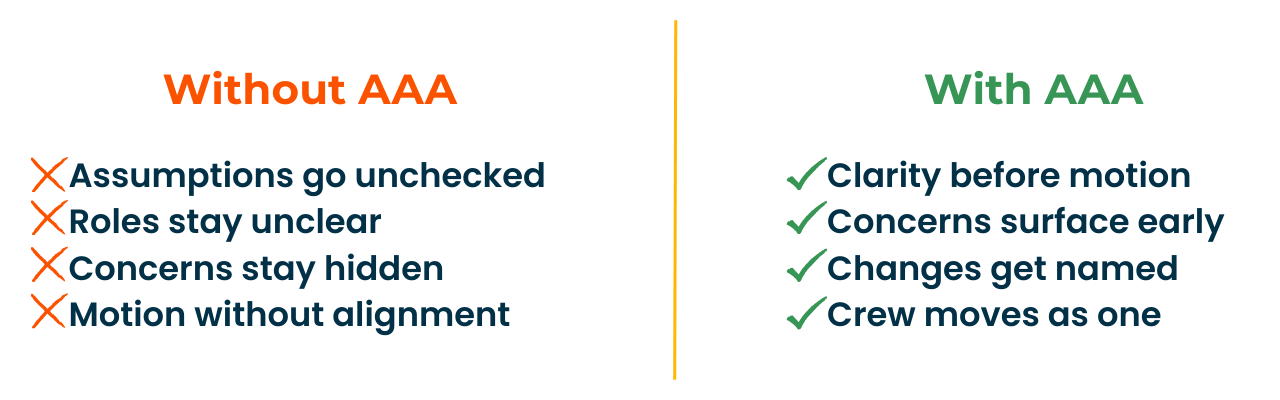
You didn't catch it at first. But now you're watching the pace shift. Communication scatters. Someone's rushing through a step they'd normally double-check. The alignment that carried the setup is gone.
This is where people get hurt. Not because the crew doesn't know better. Because nobody synced before motion.
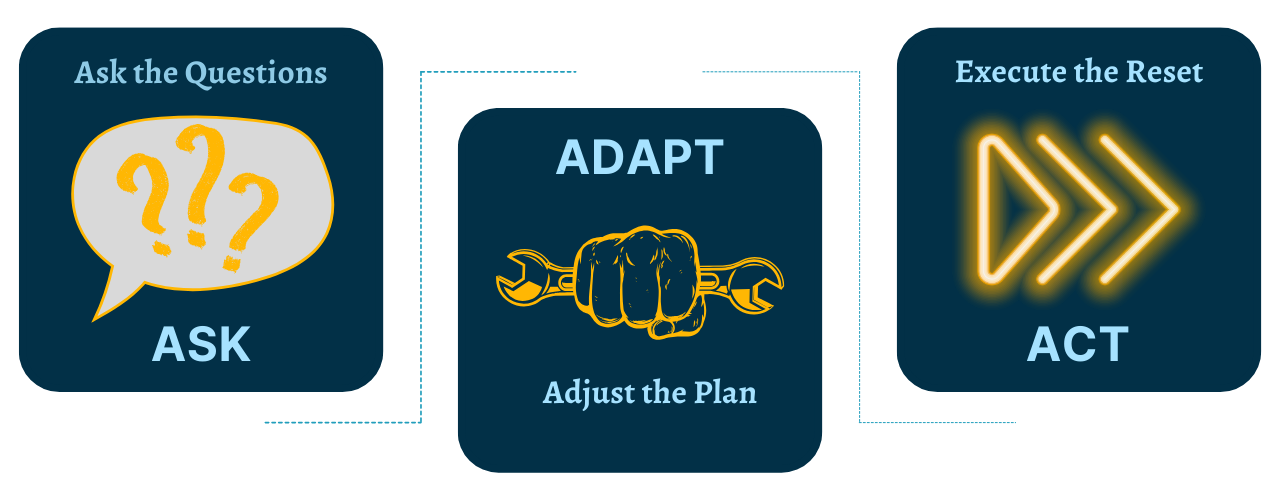
Most crews treat AAA like a briefing or a checklist. It's neither. It's a Crew Sync Ritual. A moment of leadership that creates shared clarity, surfaces risk early, and aligns intent before anyone moves.
Not optional. Essential.
Here's how to run it.
When AAA Happens
AAA isn't a mid-shift timeout or a lunch break talk. It's a pre-motion discipline.
You run it:
- Immediately after the tailboard
- Before the first move
- Any time conditions, people, or plans change
If something shifted, you sync. If you're about to move, you sync. No exceptions.
Ask: Pull Clarity from the Crew
This is not a question phase. It's a listening phase.
If the foreman talks too much here, AAA dies.
Your job is to pull clarity from the crew. Not give it to them.

Ask Question 1: Role Clarity
"What's your job on this move?"
Why it works:
- Forces people out of autopilot
- Exposes overlap, gaps, and assumptions
- Makes invisible handoffs visible
I've seen crews think they had roles covered until this question got asked. Two people thought they were operating the same piece of equipment. Another guy thought someone else was watching the ground. Nobody caught it until the question forced it into the open.
Failure mode: Foreman answers for them. People nod instead of speaking.
Leader discipline: Silence is allowed. Every voice matters, especially the quiet one. Let them answer. Don't rescue them.
Ask Question 2: Concern Check
"What's bugging you?"
Why it works:
- Cuts through fake confidence
- Normalizes discomfort
- Pulls risk out of the shadows
Most crews hide concerns because they don't want to slow things down or look weak. This question gives them permission to speak.
If someone says "nothing," follow up.
"If something goes sideways, what will it be?"
That second question changes everything. It reframes hesitation as foresight.
Failure mode: "Nothing" becomes the default answer because the foreman rushes past it.
Leader discipline: Reward honesty. Never punish it. If someone speaks up and you blow past it, they won't speak up next time.
Ask Question 3: Drift and Difference
"What are we assuming? What changed?"
Assumptions don't show up waving red flags. They hide in routine. In success. In the phrase, "We've done it this way before."
This question is your drift detector. It pulls assumptions into the light before they turn into incidents.
I ask this question on every job. Every time. And every time, something surfaces. A tool that's not quite right. A condition that shifted since the tailboard. A detail someone assumed was handled but wasn't.
Failure mode: Foreman treats it like it doesn't need an answer. Rushes the delivery. Doesn't pause.
Leader discipline: Pause after asking it. Let the discomfort work. Silence is where truth shows up.
Adapt: Adjust and Agree
This is where most frameworks fail.
If something surfaced during Ask, you respond here.
Maybe someone flagged a concern. Maybe a role wasn't clear. Maybe conditions changed. Whatever came up, you don't ignore it. You adapt.
Use this structure. Teach it exactly this way.
"Based on what we heard, what are we changing?"
Then force it into one of four buckets:

The Plan
Maybe the sequence needs adjusting. Maybe a step got missed in the tailboard. Maybe conditions shifted and the original plan no longer fits.
The People
Maybe someone's distracted and needs a different role. Maybe fatigue is showing and you need to swap positions. Maybe someone flagged a concern and you're pulling them off a high-risk task.
The Protection
Maybe PPE needs upgrading. Maybe a barrier isn't where it should be. Maybe equipment showed signs of wear and needs swapping out.
The Pace
Maybe you're rushing and need to slow down. Maybe the timeline doesn't match reality and you need to reset expectations.
Pick one. Name it. Make the change.
If someone spoke up and you blow past it, you just taught them to stop talking.
Leader discipline:
Name the change out loud. Confirm agreement, not compliance.
There's a difference. Compliance is nodding. Agreement is understanding.
A few years back, I was working a transmission line job. We ran AAA before a critical lift. One of the guys said the rigging felt off. I could've pushed through. Job was on schedule. But we adapted. Swapped out the rigging. Took an extra ten minutes.
Turned out the original rigging had a weak point we missed. If we'd moved without adapting, that lift could've gone bad.
Adaptation isn't soft. It's smart.
Now, here's the thing. There will be times when you run Ask and nothing comes up. Roles are clear. No one's concerned. Conditions haven't changed. Nothing's bugging anyone.
That's fine. That means you move to Act.
You don't force an adaptation just to prove you did AAA. You asked. The crew confirmed alignment. Now you execute.
But if something did surface and you don't adapt, that's where trust dies.
Act: Execute with Alignment
This is not "go to work."
This is intentional execution.
Add a signature move here. Don't skip this.
"Say your first move."
One by one. Short. Clear.
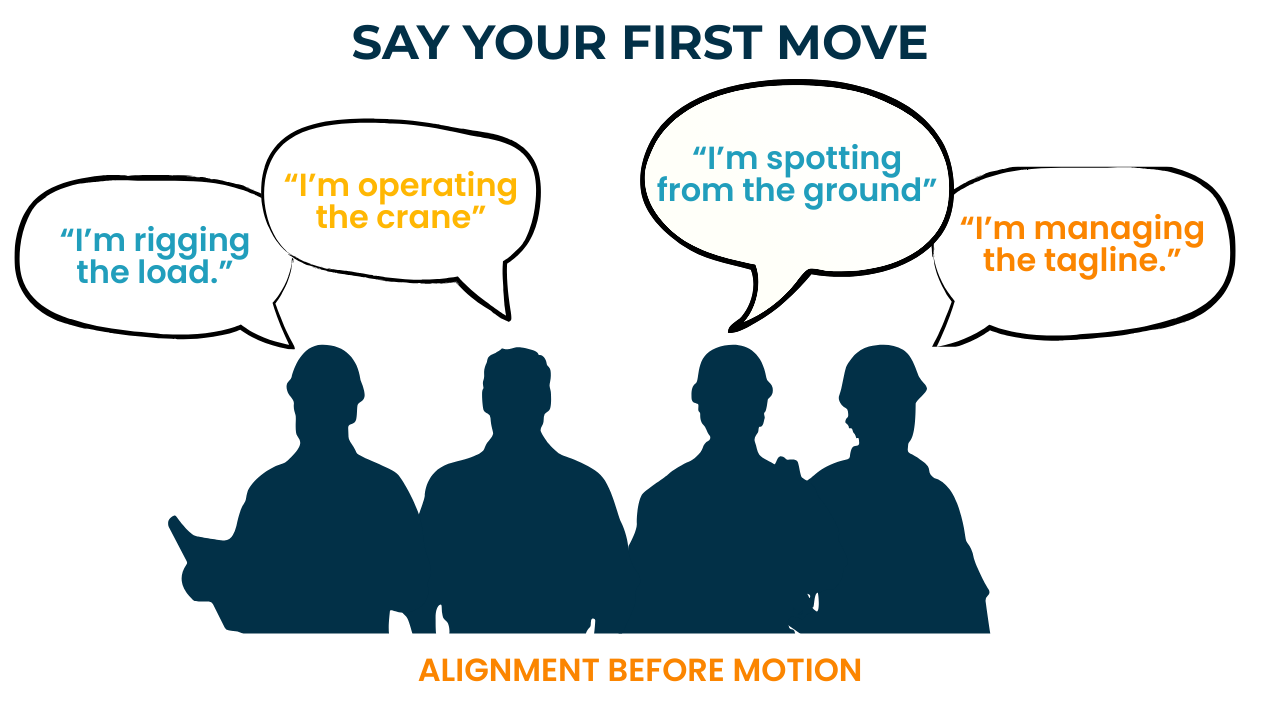
Why this matters:
- Exposes misunderstanding instantly
- Synchronizes timing
- Eliminates silent assumptions
I've watched this step catch more near-misses than anything else in AAA. Someone says their first move and another crew member realizes they were about to do the same thing at the same time. Or someone says their move and you realize they misunderstood the plan entirely.
Better to catch it here than in motion.
Failure mode: Foreman skips it because it feels awkward.
Truth: Awkward is cheaper than an incident.
Leader discipline: Make every person say it. No shortcuts. No assumptions.
Want this framework in a field-ready format?
I built a one-page AAA Field Guide you can print, laminate, and use on the job tomorrow.
It includes the three questions, the four buckets, and the "Say Your First Move" protocol—everything you need to run AAA with your crew.
Why This Works
AAA works as a Crew Sync Ritual because it's predictable, repeatable, fast, and expected.
Crews feel it when it's missing.
AAA works as a Leadership Discipline because it forces listening, builds trust through action, and trains foremen to lead conversations, not just tasks.
This is where culture shifts.
Not in a safety meeting. Not on a poster. In the moment before motion when a leader creates space for truth, adapts to what they hear, and aligns the crew before anyone moves.
Where Leaders Kill AAA
AAA doesn't survive weak leadership.
If you're going to run AAA, run it right. Because half-executed AAA is worse than no AAA at all. You teach your crew that safety is box-checking. And they stop trusting you.
Here's how most foremen kill it:
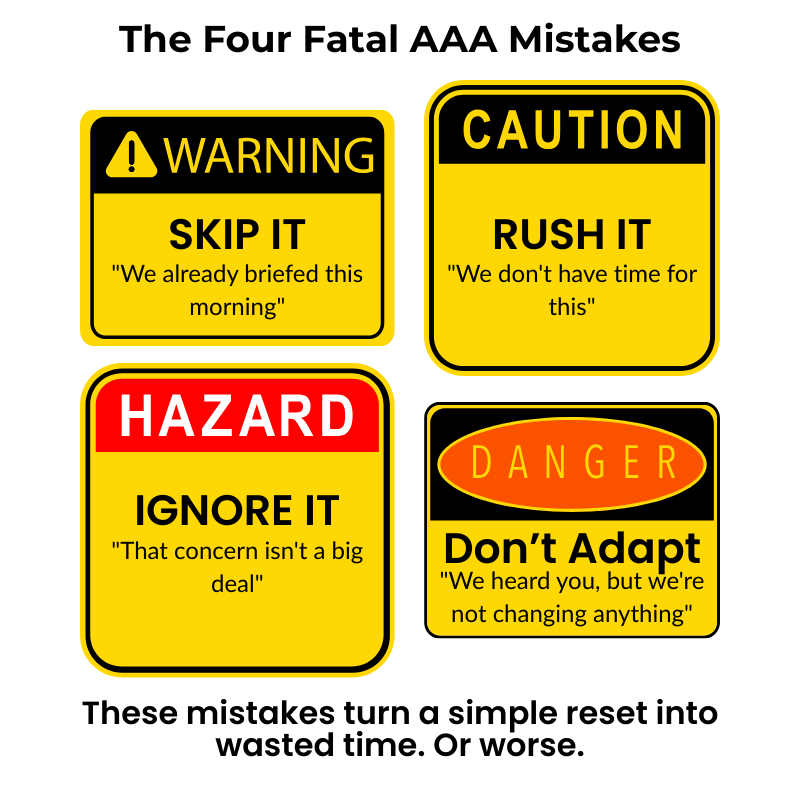
Fatal Mistake #1: They Skip It
"We already briefed this morning."
Wrong. The tailboard sets the plan. AAA syncs the crew before execution. Those are different things.
The tailboard tells you what the job is. AAA makes sure everyone knows what they're doing right now, on this specific move, with these specific people, under these specific conditions.
Conditions drift. People forget. Assumptions hide. If you skip AAA because "we already covered it," you're moving on outdated alignment.
Where it saves lives:
When someone finally says, "Wait—I thought you had that."
Fatal Mistake #2: They Rush It
"We don't have time for this."
You don't have time not to do this.
When you rush AAA, you ask questions just to check a box. The crew knows when you're going through the motions. They'll give you box-checking answers.
"What's your job?" → "Same as always." "What's bugging you?" → "Nothing." "What are we assuming?" → "Nothing's changed."
You just burned 90 seconds and learned nothing. That's not AAA. That's box-checking.
The fix: Slow down enough to actually hear the answers. If someone says "nothing," follow up. "If something goes sideways, what will it be?" That second question changes everything.
Where it saves lives:
When someone finally admits, "I'm not comfortable with this approach."
Fatal Mistake #3: They Ignore Feedback
"That concern isn't a big deal."
If someone raises a concern and you blow past it, you just taught that person not to speak up next time.
I've watched foremen ask "What's bugging you?" and then dismiss the answer because they don't want to slow down. Or because the concern seems minor. Or because they're already committed to the plan.
That's worse than skipping AAA entirely. Because now the crew knows: You don't actually care what they say. You just want to appear like you care.
The cost:
Trust dies. Concerns stay hidden. Incidents happen.
Where it saves lives:
When a small change gets named before motion—and you actually make the change.
Fatal Mistake #4: They Don't Adapt
"We heard you, but we're not changing anything."
You asked. You listened. Then you did nothing.
This is the death blow. You went through Ask. People spoke up. Concerns surfaced. Roles got clarified. Maybe something changed since the tailboard.
And then you said, "Okay, let's go."
No adaptation. No adjustment. No acknowledgment that what they said mattered.
If you're not willing to adapt based on what you hear, don't ask. Because asking and ignoring is worse than not asking at all. You just weaponized AAA against yourself.
The fix: If something surfaced during Ask, respond in Adapt. Name the change. Pick one of the four buckets (Plan, People, Protection, Pace). Make the adjustment. Confirm agreement.
If nothing came up during Ask? That's fine. Move to Act. You don't force an adaptation just to prove you did AAA. But if something did surface and you don't adapt, that's where trust dies.
This is where lives get saved: When alignment replaces assumption. When the crew moves as one because they know the plan just got better.
The Pattern You Need to See
Every one of these failures has the same root cause: Leaders are afraid.
Afraid of silence.
Afraid of slowing down.
Afraid of looking uncertain.
Afraid of changing the plan.
AAA forces you to face those fears. To hold space for truth. To adapt when conditions demand it. To lead conversations, not just tasks.
If you can't do that, AAA won't work. But the problem isn't AAA. The problem is leadership.
Three Moves That Lock This In
If you want AAA to stick, do these three things.
1. Standardize the exact wording foremen use.
No freelancing. Language consistency creates ritual.
Teach every foreman to ask the same three questions the same way every time. When the crew hears the same wording on every job with every foreman, it becomes expected. Predictable. Normal.
2. Make "Say your first move" mandatory.
This turns Act into alignment instead of motion.
Don't let foremen skip this step. It feels awkward at first. Do it anyway. After the first time it catches a misunderstanding, no one will question it again.
3. Train leaders to hold silence without rescuing it.
Silence is where truth shows up.
Most foremen are afraid of silence. They ask a question and if no one answers immediately, they answer it themselves or move on. That kills AAA.
Teach them to wait. Count to five in their head. Let the crew think. Let the discomfort work.
The best answers come after the pause.
How to Teach AAA
Don't teach AAA in a classroom. Don't teach it on a slide. Don't make it a policy memo that shows up in someone's inbox.
Teach it on the ground. In real jobs. With real stakes.
Here's how to make it stick.
Week 1: Introduce the Framework
What happens:
You run AAA after the tailboard. You lead it. You ask the three questions. You adapt if needed. You make everyone say their first move.
The crew is learning the rhythm. They're hearing the questions for the first time. Some of them will be uncomfortable. That's fine. Discomfort means it's working.
Your job:
Model the discipline. Don't rush. Don't skip steps. Show them what it looks like when it's done right.
What you say afterward:
"That's AAA. We're doing this before every major move from now on. It takes 3-5 minutes. It keeps us aligned. You'll see why it matters."
Don't over-explain. Don't defend it. Just do it.
Week 2: Explain the 'Why' After It Catches Something
What happens:
You run AAA again. This time, someone speaks up. Maybe they flag a concern. Maybe two people realize they were about to do the same task. Maybe "Say your first move" exposes a misunderstanding.
Your job:
Stop and name it. Right there. In the moment.
"We just AAA'd that. That's why we didn't rush. If we'd skipped this step, we would've had [specific consequence]. This is what alignment looks like."
Why this matters:
The crew needs to see AAA work in real time. Not in theory. Not in a safety meeting. On the job. When it prevents something real.
That's when it clicks. That's when they stop seeing it as a ritual and start seeing it as a tool.
Week 3: Hand Off Facilitation (Selectively)
What happens:
You let a journeyman or lead hand run AAA. You're still there. You're watching. But you're not leading it.
Your job:
Coach them afterward. "You rushed Question 2. Slow down. Let the silence work." Or, "Good job holding the pause after you asked about assumptions. That's where the truth is."
Why this matters:
AAA can't be the foreman's job forever. It has to become crew discipline. The way you build that is by teaching others to facilitate it.
Start with your strongest people. The ones who already speak up. The ones the crew respects. Let them lead AAA on lower-risk tasks. Build their confidence.
Week 4: Make It Expected
What happens:
By Week 4, the crew expects AAA. If you try to skip it, someone will ask, "Are we running AAA first?"
That's the moment you know it's working.
Your job:
Reinforce the expectation. "Yes. Every time. Before motion."
What you're building:
A crew that feels it when AAA is missing. A crew that won't move without alignment. A crew that self-regulates because the ritual has become normal.
Month 2 and Beyond: Tighten Execution
Once AAA is established, focus on quality, not just consistency.
Watch for these failure modes:
1. AAA becomes a formality.
People go through the motions. They ask the questions but don't pause for answers. They say their first move but don't actually listen to each other.
The fix:
Catch it early. "That wasn't AAA. That was box-checking. Run it again. This time, actually listen."
2. Only the foreman runs it.
If only the foreman facilitates AAA, you've created a single point of failure. What happens when the foreman's not there?
The fix:
Rotate facilitation. Train multiple people to lead it. Build redundancy.
3. AAA gets skipped under time pressure.
You're behind schedule. Someone says, "We don't have time for this." And you let them skip it.
The fix:
Hold the line. "We don't have time not to do this. If we screw this up because we rushed, we lose more time than AAA takes."
Time pressure is exactly when AAA matters most. That's when people drift. That's when assumptions hide. That's when incidents happen.
How to Standardize AAA Across Your Organization
If you want AAA to work at scale—across multiple crews, multiple sites, multiple leaders—you need standardization.
Here's the playbook:
1. Teach the exact wording.
Don't let foremen freelance the questions. Language consistency creates ritual.
Every foreman asks:
- "What's your job on this move?"
- "What's bugging you?"
- "What are we assuming?"
Same words. Same sequence. Every time.
Why this matters:
When the crew hears the same questions on every job with every foreman, it becomes expected. Predictable. Normal. They know what's coming. They know how to respond.
2. Make "Say your first move" non-negotiable.
This is the signature move. This is what separates AAA from every other pre-job brief.
Train every foreman to say: "Before we move, everyone say your first move. One at a time. Short and clear."
Then make them wait. Make every person speak. No shortcuts. No assumptions.
Why this matters:
This step catches more near-misses than anything else in AAA. It's uncomfortable. It feels slow. Do it anyway.
After the first time it prevents an incident, no one will question it again.
3. Train leaders to hold silence without rescuing it.
Most foremen are terrified of silence. They ask a question, and if no one answers immediately, they answer it themselves or move on.
That kills AAA.
Teach them to pause. To count to five in their head. To let the discomfort work. To let the crew think.
The best answers come after the pause.
Someone might need a few seconds to find the words. Someone might be deciding whether to speak up. Someone might be processing whether their concern is worth mentioning.
If you rush past the silence, you lose all of that.
Leader discipline:
Ask the question. Then wait. Let the crew fill the space.
4. Reinforce it when it works. Correct it when it doesn't.
If you see a foreman skip AAA, address it immediately.
"Why didn't you run AAA before that move?"
If they say, "We didn't have time," your response is: "You don't have time not to. Run it. Every time."
If you see a foreman rush through AAA, pull them aside afterward.
"You asked the questions. But you didn't pause for answers. That's not AAA. That's box-checking. Next time, slow down."
And when you see it done right? When a foreman holds the silence, adapts based on feedback, and aligns the crew before motion?
Recognize it. Publicly.
"That's how you run AAA. That's leadership."
What AAA Looks Like After 90 Days
When AAA is fully embedded, here's what you'll see:
Crews run it without being told.
Before every major move, someone says, "Let's AAA this." It's automatic.
People speak up more.
Because they've learned that concerns are valued. That adaptation happens. That speaking up makes things better, not worse.
Near-misses get caught before motion.
Not after. Not during. Before. Because alignment happens before anyone moves.
Trust increases.
Crews trust their leaders because leaders listen and adapt. Leaders trust their crews because crews surface concerns early.
Incidents decrease.
Not because people got smarter. Because alignment replaced assumption. Because silence was given space. Because motion happened after clarity, not before.
The One Thing You Can't Delegate
You can teach AAA. You can train foremen. You can standardize the language. You can reinforce the ritual.
But you can't delegate belief.
If leadership doesn't believe AAA matters, the crew won't either.
If you skip it under time pressure, they'll skip it too.
If you rush it, they'll rush it too.
If you ask but don't adapt, they'll stop answering.
AAA is a mirror. It reflects the discipline of the person running it.
If you want it to work, you have to model it. Every time. No exceptions.
That's how culture shifts. Not in a meeting. Not on a poster. In the moment before motion when a leader creates space for truth, adapts to what they hear, and aligns the crew before anyone moves.
The Bottom Line
AAA is a Crew Sync Ritual powered by Leadership Discipline.
Three questions. Four buckets. One signature move.
Ask pulls clarity. Adapt forces change. Act creates alignment.
Before motion. Every time.
Crews don't get hurt because they don't know better. They get hurt because assumptions hide, roles blur, and nobody syncs before the move.
AAA fixes that.
Every worker deserves to go home safe. This is how you make sure they do.


Responses